Bloat (GDV) in German Shepherds (Emergency)
Bloat (GDV) in German Shepherds is a life-threatening emergency. Learn the warning signs, risk factors and prevention, and go to a vet immediately.
2 min readUpdated 2026-09-28
Emergency: if your dog's belly swells, or it tries to vomit and nothing comes up, go to a vet immediately. Don't wait, and don't try any home treatment [1][2][3].
Bloat is one of the few dog problems where minutes really count. It mostly hits large, deep-chested dogs, and vets describe the German Shepherd as higher-than-average risk [2][3]. Here's what every owner should know.
What is bloat (GDV) in dogs?
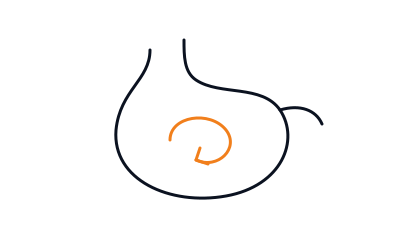
- The stomach fills with air, fluid or food and swells [1][2][3].
- Then it twists on itself [1][2][3].
- The twist cuts off blood flow. Without emergency vet care, it can quickly lead to organ damage and death [1][2][3].
It's not an infection and doesn't spread between dogs [1][2][3].
What are the signs of bloat?
Go to the nearest vet immediately if you see:
- A swollen or tight belly [1][2][3].
- Retching with nothing coming up [1][2][3].
- Heavy drooling, restlessness, or looking at its belly again and again [1][2][3].
- Fast panting, weakness, pale gums or collapse [1][2][3].
- A "praying" pose: chest down, rear end up [1].
Why are German Shepherds at risk?
Their size and deep chest put them in the higher-risk group [2][3]. Other risk factors include [1][2][4]:
- Getting older.
- A parent or sibling that had bloat.
- Eating fast, or one big meal a day.
- Exercising soon after eating.
How can I lower the risk?
There's no guaranteed prevention, but these habits help [1][2]:
- Two or more smaller meals a day.
- Food bowl on the floor, not raised.
- No hard exercise just before or after meals.
Did you know? Raised food bowls are often sold "for big dogs", yet vet sources list them as a bloat risk factor and advise avoiding them [1][2].
FAQ
What should I do the moment I see signs?
Go to a vet immediately. Don't wait, and don't try anything at home [1][2][3].
Is bloat contagious?
No. It's a sudden physical event, not an infection [1][2][3].
What is a preventive gastropexy?
A preventive surgery that attaches the stomach to the body wall, making a dangerous twist much less likely [2]. Whether it suits your dog is a question for a licensed vet.
Sources (4)
The official and scientific references behind this article.
- Gastric Dilation and Volvulus in Small Animals — Merck (MSD) Veterinary Manual, https://www.merckvetmanual.com/digestive-system/surgical-problems-of-the-gastrointestinal-tract-in-small-animals/gastric-dilation-and-volvulus-in-small-animals (accessed 2026-09-28)
- Gastric Dilatation-Volvulus — American College of Veterinary Surgeons (ACVS), https://www.acvs.org/small-animal/gastric-dilatation-volvulus/ (accessed 2026-09-28)
- Gastric dilatation-volvulus (GDV) or "bloat" — Cornell University College of Veterinary Medicine, Riney Canine Health Center, https://www.vet.cornell.edu/departments-centers-and-institutes/riney-canine-health-center/canine-health-topics/gastric-dilatation-volvulus-gdv-or-bloat (accessed 2026-09-28)
- Incidence of and breed-related risk factors for gastric dilatation-volvulus in dogs; Non-dietary risk factors for gastric dilatation-volvulus in large and giant breed dogs (Glickman LT, Glickman NW, et al., 2000) — Journal of the American Veterinary Medical Association, https://avmajournals.avma.org/view/journals/javma/217/10/javma.2000.217.1492.xml (accessed 2026-09-28)
Was this helpful?
Share it with someone who cares
Send it to a friend or family member who has a pet. It might help them too.
Ask a question
Have a question about “Bloat (GDV) in German Shepherds (Emergency)”? Ask privately. We’ll add vet-checked answers to selected questions in the FAQ.
Suggest an article
Is there a pet topic you'd like us to write about? Tell us, and we'll add the most-asked ones to the Encyclopedia.
- Every article uses only reliable, official sources (government bodies, veterinary schools and associations, published research), listed under the article.
- Health articles are checked by a licensed vet as our vet reviewers join. An article shows the vet's name only once a vet has checked it.
- Articles give general guidance, not a diagnosis or treatment. If your pet seems unwell, contact a vet.
What you can do next
Dogs across wasmID
Everything on wasmID for this animal, in one place.